



Navigating Climate Resilience and Regenerative Agriculture: Strategic Value Realignment of Potassium Humate in Global Agrochemical Procurement
As global agricultural production faces escalating challenges from extreme drought, soil salinization, and unpredictable climate volatility, the purchasing logic of international buyers, agribusiness conglomerates, and agricultural technical teams is undergoing a profound transformation. The historical procurement model, which focused almost exclusively on high-analysis NPK synthetic fertilizers, can no longer meet the modern farm enterprise's holistic demands for crop stress resilience, soil health maintenance, and environmental carbon reduction compliance.
At this pivotal industry turning point, high-grade Potassium Humate is transitioning from a localized soil amendment to an indispensable strategic core commodity within the global agricultural supply chain, driven by its dual capabilities in ecological restoration and nutrient efficiency enhancement.
Overcoming Extreme Environmental Stress: From Soil Restructuring to Root Resilience Activation
One of the main operational pain points in modern large-scale farming is soil degradation, characterized by organic matter depletion, compaction, and diminished cation exchange capacity resulting from continuous intensive tillage. Under drought or saline-alkaline stress, compromised soil ecosystems lead to rapid crop quality degradation and severe yield losses.
The core value of this natural mineral-derived input lies in its dual regulating action on both soil structure and plant physiology. Serving as an exceptional organic Soil Conditioner, it replenishes essential humic substances, rebuilding beneficial macro- and micro-aggregate structures that significantly expand soil water-retention capacity and aeration. In salinized regions, active functional groups within the humic matrix naturally complex excess sodium ions, effectively reducing electrical conductivity and mitigating osmotic stress on developing root zones.
Furthermore, acting as a potent Plant Growth Stimulant, it triggers endogenous hormone signaling pathways that encourage deeper and denser root network architecture. This expanded root volume directly improves the plant's capacity to forage for subterranean water and essential micro-nutrients during extended dry spells.
Empowering Regenerative Agriculture and ESG Compliance: Fertilizer Efficiency and Carbon Footprint Reduction
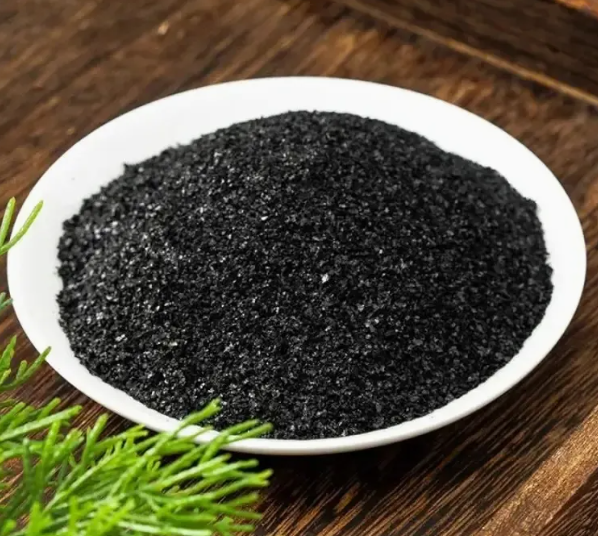
With major agricultural exporting nations progressively enforcing synthetic input reduction mandates and rigorous carbon footprint audits, commercial farms and chemical distributors encounter unprecedented regulatory pressure. Incorporating ultra-pure, 100% Soluble Potassium Humate into soil fertility programs stands as one of the most effective strategies to achieve fertilizer reduction without sacrificing crop yield targets.
When co-applied with conventional inorganic inputs, humic substances temporarily bind volatile nitrogen compounds to prevent leaching and volatilization. Simultaneously, they reactivate fixed phosphorus and bound micronutrients within the soil matrix, transforming them back into bioavailable forms ready for plant uptake. This synergistic nutrient-activation mechanism directly helps commercial growers reduce total chemical fertilizer application per hectare, optimizing downstream crop quality while earning crucial sustainability credentials and superior ESG ratings for international market access.
Building a Resilient Global Commodity Supply Chain Framework
For international volume procurement teams, superior chemical specifications represent only half of a successful sourcing agreement; a stable, compliant, and continuous supply chain delivery network forms the real foundation of enduring commercial partnerships. Chemical manufacturing leaders with advanced extraction technology and rigorous quality control standards are uniquely positioned to deliver highly uniform, anti-caking, and rapid-dissolving products tailored for diverse irrigation infrastructure worldwide.
From the rigorous selection of high-purity leonardite raw materials to the precise regulation of active humic and fulvic acid contents, alongside standardized export-grade moisture-barrier packaging, establishing a transparent and robust supply framework provides global buyers with a strong commercial buffer against market price fluctuations and shipping logistics risks.
In the face of a global agricultural transition toward low-carbon resilience and long-term sustainability, integrating premium humic inputs into core procurement portfolios is far more than a simple product line extension—it is a forward-looking strategic investment in the future of sustainable farming.